
Developing Brand Identity: How to Sharpen Your Brand Profile
Table of Content
A strong brand identity is more important today than ever before. Companies face the challenge of clearly positioning themselves in a highly competitive market and remaining anchored in consumers’ minds. But what makes a distinctive brand? And how can a brand identity be deliberately developed and strengthened over the long term?
In this article, you’ll discover why a clear brand identity is essential, what elements it encompasses, and what strategies you can use to sharpen your brand profile. We’ll also explore how online surveys can be used as a valuable tool for analyzing and optimizing brand identity.
What is Brand Identity?
Brand identity is the self-image of a brand – it defines who the brand is, what it stands for, and what values it conveys. Unlike brand image, which describes how the brand is perceived by outsiders, brand identity is actively shaped by the company.
A strong brand identity builds trust, distinguishes a brand from its competition, and ensures clear recognition. It forms the foundation for consistent brand communication and influences how customers perceive and interact with a brand.
Difference Between Brand Identity and Brand Image
Although brand identity and brand image are closely connected, there is a clear distinction:
Brand Identity | Brand Image |
| Self-image of the brand | External perception of the brand |
| Actively defined by the company | Perceived by customers and market participants |
| Long-term stable | Can change through experiences and communication |
| Shaped by brand values, communication, and design | Created through customer opinions, experiences, and external influences |
A company’s goal is to communicate its brand identity so clearly and consistently that the brand image aligns with it. If the external perception doesn’t match the desired identity, adjustments in communication or strategy must be made.
The Dimensions of Brand Identity
A brand identity consists of several dimensions that collectively form the overall image of a brand. According to the identity model by Jean-Noël Kapferer, one of the most renowned branding experts, there are six central aspects of a brand identity:
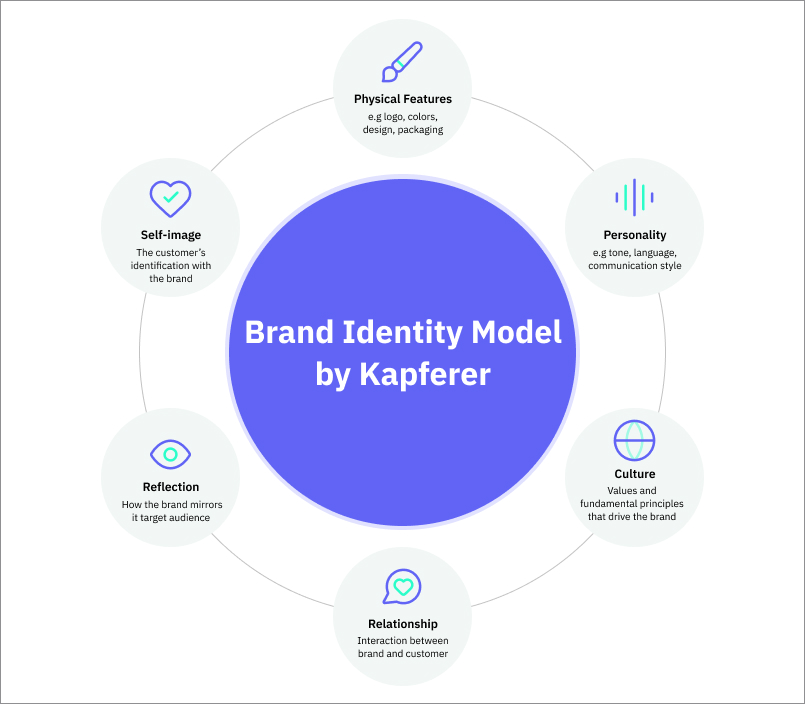
- Physical Features – The visible, sensory properties of the brand, such as logo, colors, design, and packaging.
- Personality – The character of the brand, expressed through tone, language, and communication style.
- Culture – The values and fundamental principles that drive the brand and make it tangible to the outside world.
- Relationship – The type of interaction between brand and customer, e.g., whether the brand is perceived as consultative, innovative, or exclusive.
- Reflection – How the brand mirrors its target audience – for example, a luxury brand embodying wealth and prestige.
- Self-image – The customer’s identification with the brand: What feeling does it convey to them?
These dimensions help companies strategically define and deliberately manage their own brand identity.
Distinction from Brand Positioning and Branding
The terms brand identity, brand positioning, and branding are often used synonymously. However, there are clear differences:
- Brand Identity describes the self-image of the brand – the values, characteristics, and attributes that define a brand. It is the foundation of every successful brand strategy.
- Brand Positioning describes how a brand differentiates itself in the market and from competitors. It determines what place the brand should occupy in the minds of the target audience.
- Branding encompasses all measures that make the brand identity visible and tangible – from designing the logo to the tone of communication.
While brand identity remains stable over the long term, positioning can be adapted to changing market conditions. Branding, in turn, ensures that the defined brand values and messages are effectively conveyed to the outside world.
The Core Elements of a Brand Identity
A strong brand identity consists of several core elements that collectively shape the image of the brand. They ensure that a brand is memorable, consistent, and unique.
- Brand Values and Brand Personality
The brand values are the foundation of every brand identity. They describe what the brand stands for and what convictions it represents. Typical brand values include innovation, sustainability, quality, or customer focus. Companies should clearly define their values, as they serve as guidance for all decisions and communications.
The brand personality makes a brand tangible and emotionally relatable. It describes the characteristic traits of a brand, similar to those of a real person. A well-known model is the Brand Personality Framework by Jennifer Aaker, which distinguishes five dimensions of brand personality:
Brand Personality | Example Brands |
| Sincerity – honest, down-to-earth, friendly | Disney, Dove |
| Excitement – trendy, dynamic, adventurous | Red Bull, Tesla |
| Competence – reliable, intelligent, successful | Microsoft, Mercedes-Benz |
| Sophistication – luxurious, exclusive, stylish | Rolex, Chanel |
| Ruggedness – powerful, outdoorsy, durable | Jeep, Harley-Davidson |
Companies should ensure that their brand values and personality are consistently conveyed across all communication channels.
- Visual Identity and Brand Communication
The visual identity ensures that a brand is visually distinctive. It includes elements such as:
- Logo (e.g., Apple’s bitten apple)
- Colors (e.g., Coca-Cola red or Nivea blue)
- Fonts (e.g., modern vs. classic typography)
- Imagery (e.g., minimalist, playful, premium)
- Design elements (e.g., packaging style, website layout)
A consistent visual appearance increases a brand’s recognition value and makes it easier for customers to identify with it.
The brand communication determines how a brand speaks and presents itself. This includes:
- Tone (e.g., factual, emotional, humorous)
- Slogans and claims (e.g., Nike’s “Just Do It”)
- Messages and storytelling
A well-thought-out combination of visual identity and language ensures that the brand is perceived as unified and authentic in every customer interaction.
- Brand Story and Consistency
The brand story is a powerful tool for building an emotional connection with the target audience. It tells why the brand exists, what challenges it has overcome, and what drives it. A good example is Tesla, which started with the mission of making sustainable mobility accessible to everyone.
At the same time, consistency is crucial: A brand should remain true to its core over the years to build trust and recognition. Studies show that consistent brands exhibit up to 3.5 times higher brand loyalty than inconsistent brands.
Strategies for Developing and Strengthening a Brand Identity
Developing a strong brand identity requires a strategic approach, clarity about your own values, and consistent implementation. The following steps will help you build and solidify a distinctive brand identity over the long term.
- Target Audience Analysis as a Foundation
A brand can only be successful if it understands the needs and expectations of its target audience. Therefore, a detailed target audience analysis is the first step:
- Demographic characteristics: age, gender, income, education
- Psychographic characteristics: values, interests, purchase motives
- Behavior: shopping habits, media usage, brand loyalty
Valuable insights can be gained through online surveys, market studies, and customer interviews.
Example: A sustainable fashion label can use surveys to discover whether customers value fair production or recycled materials more – and adapt its communication accordingly.
- Define Brand Mission, Vision, and Values
- Brand mission: Why does the brand exist? What problem does it solve?
- Brand vision: Where should the brand be in the future?
- Brand values: What principles shape the brand and how are they lived externally?
An example is Patagonia, whose mission is clearly focused on sustainability: “We’re in business to save our home planet.”
- Differentiation and Positioning in the Market
To stand out from competitors, a brand must develop a clear positioning. This includes the Unique Value Proposition (UVP) – the central promise to customers.
A strong positioning answers questions such as:
- What makes my brand unique?
- Why should customers choose my brand?
- How does it differ from competitors?
Example: Tesla positions itself not just as a car manufacturer, but as a technology company focused on sustainable innovation.
- Ensure Consistency in Brand Communication
For a brand to remain successful, it must appear uniform across all channels. This includes:
- A consistent corporate design (colors, fonts, imagery)
- A clear brand voice and tone (e.g., friendly and approachable or factual and competent)
- Coherent content and messages (across website, social media, advertising, and customer service)
Brands like Apple or Nike have managed to establish an unmistakable style through consistent communication.
- Measuring and Adjusting Brand Identity
Brand identity should be regularly reviewed to ensure it aligns with the target audience’s perception. This can be done through:
- Brand awareness surveys
- Image analyses
- Customer feedback and social listening
If a discrepancy between brand identity and brand image is identified, targeted adjustments in communication or positioning should be made.
Analyze Brand Identity Strategically with Online Surveys
With resonio, you can easily create brand perception surveys and gain valuable insights. Identify strengths, optimize your branding, and ensure consistent brand communication.
More about the brand research platformOnline Surveys as a Tool for Brand Development
The perception of a brand constantly changes – due to market trends, new competitors, or changing customer needs. To ensure that your own brand identity is clearly defined and properly anchored in the market, online surveys are an effective tool. They provide valuable insights into whether the desired brand image is actually reaching the target audience.
With resonio, companies can create precise online surveys to regularly analyze their brand identity and strategically develop it further.
Why Are Online Surveys Important for Brand Identity?
Online surveys enable companies to systematically collect data on brand perception and make informed decisions for their brand strategy. They help answer questions such as:
- How is my brand perceived by the target audience?
- Which brand values are associated with my company?
- How strongly does my brand image differ from my competitors?
- How consistent is the perception across different customer segments?
With resonio, companies can easily and quickly clarify these and other questions. The platform allows you to create targeted surveys on brand perception and evaluate the results in visual dashboards.
Which Questions Help Sharpen Brand Identity?
The right design of surveys is crucial. Here are some typical questions that help analyze and purposefully develop brand identity:
Question Type | Example Question | Goal |
| Association Questions | “What three terms come to mind when you think of our brand?” | Measure brand perception |
| Image Evaluation | “On a scale of 1 to 10: How innovative/traditional/approachable does our brand appear to you?” | Verify positioning |
| Comparison with Competitors | “Which brand comes to mind first when you think of [industry]?” | Measure brand awareness |
| Purchase Motives | “What prompted you to choose our brand?” | Validate USP from the customer’s perspective |
| Communication Assessment | “How well does our advertising reflect the values of our brand?” | Check consistency of brand message |
With resonio, these questions can be flexibly adapted and supplemented with images, videos, or interactive elements to enable an even deeper analysis of brand perception.

Best Practices for Using Online Surveys
For online surveys to deliver meaningful and usable results, the following aspects should be considered:
- Targeted audience selection: Survey the right customer group – existing customers, potential new customers, or even competitors’ users.
- Regular surveys: One-time feedback is not enough. Repeated surveys show trends and changes in brand perception.
- Clear, understandable questions: Complicated or ambiguous questions can lead to distorted results.
- Short survey duration: Online surveys should not take longer than 5–10 minutes to avoid dropouts.
- Use visual elements: Incorporate logos or advertisements in surveys to test reactions to design and branding.
With resonio, companies can easily implement these best practices – from targeted sampling to quick and efficient data analysis.
Practical Examples: How Brands Use Online Surveys
The following examples show how companies use resonio to gain valuable insights into their brand identity and perception.
- Testing brand awareness: A tech startup surveys consumers with resonio to analyze how well-known their brand already is among the target audience.
- Checking slogan effectiveness: A fashion company tests two different advertising slogans through resonio to see which one better fits the brand.
- Securing rebranding decisions: An insurance company submits several new logo designs for voting and chooses the preferred version based on survey results.
Using Survey Insights Effectively
Online surveys provide valuable data on brand identity – but the real value comes from correct interpretation and implementation of the results. In this section, you’ll learn how to derive concrete measures from the collected data, strategically optimize your brand strategy, and build a strong brand identity over the long term.
- Structured Analysis of Results
After conducting an online survey, a variety of data is available. A systematic analysis is required to gain valuable insights.
Recommended steps for data analysis:
- Segmentation: Break down results by target groups, age, purchasing behavior, or other relevant characteristics.
- Identify trends: Are there clear patterns or recurring themes in the responses?
- Make comparisons: Do perceptions differ between existing customers and new customers? Are there discrepancies between internal brand identity and external brand image?
- Set priorities: Which insights have the greatest impact on the brand strategy?
With resonio, survey results can be visualized directly in graphical dashboards (survey reports) and filtered according to various criteria. This allows you to quickly identify where action is needed.
- Define Key Action Areas
Once the analysis is complete, companies should derive targeted measures. Typical scenarios and possible strategic adjustments:
Insight from the Survey | Possible Measures |
| Customers perceive the brand as not very innovative | Focus product development and communication more on innovation, use modern designs |
| Brand values are not clearly perceived | Optimize storytelling across website, social media, and advertising; refine brand messages |
| The brand is associated with the wrong attributes | Review branding and visual identity, adjust advertising campaigns |
| Brand awareness is lower than expected | Adjust marketing strategy, implement more targeted advertising measures |
| Brand perception varies greatly between customer segments | Develop different communication strategies for various target groups |
With resonio, companies can conduct A/B tests to test different strategies and determine which approaches deliver the best results.
- Integrate Measures into Brand Strategy
The derived measures should not remain isolated but should be embedded in the overall brand strategy. This includes:
- Involvement of all relevant departments: Marketing, product development, sales, and customer service must communicate the new brand messages uniformly.
- Adjustment of communication guidelines: All marketing materials, social media strategies, and customer interactions should be adapted to the optimized brand identity.
- Employee training: For the brand to appear authentic, all internal teams should understand how the brand identity should be conveyed externally.
- Measuring Success and Continuous Optimization
A brand identity is not a rigid concept – it needs to be regularly reviewed and optimized. Therefore, it’s important to conduct performance measurements:
- Recurring online surveys on brand perception
- Analysis of social media sentiments and customer reviews
- Monitoring of KPIs such as brand awareness, brand loyalty, or customer satisfaction
Through continuous monitoring with resonio, companies can recognize early whether their measures are working – or if further adjustments are needed.
Strengthen Your Brand Identity with Online Surveys
With resonio, you can easily create brand perception surveys and gain valuable insights. Identify strengths, optimize your branding, and ensure consistent brand communication.
Learn more about brand research with resonioConclusion: Brand Identity as a Success Factor
A clearly defined and consistently communicated brand identity is the key to a strong market position, higher customer loyalty, and long-term success. Companies that deliberately develop their brand values and strategically build their identity can sustainably differentiate themselves from the competition.
The key insights at a glance:
- Brand identity is the self-image of a brand and should be clearly distinguished from brand image and brand positioning.
- The core elements of a brand identity – brand values, visual identity, language, and consistency – must work harmoniously together.
- Strategic development through target audience analysis, clear differentiation, and consistent brand communication is crucial.
- Online surveys help objectively measure brand perception and make targeted adjustments.
- Continuous analysis and optimization of brand identity ensures that it aligns with the expectations of the target audience.
Companies that regularly conduct market research and respond to customer feedback can strengthen their brand long-term and establish an authentic, consistent brand image.
FAQ – Common Questions About Brand Identity
Why is a strong brand identity important?
A clear brand identity helps companies stand out from the competition, build trust with the target audience, and foster long-term brand loyalty. It also influences purchasing decisions and the perception of the brand in the market.
How does brand identity differ from brand image?
Brand identity describes the self-image of a brand – how it defines and wants to present itself. Brand image, on the other hand, is the external perception, or how the brand is actually perceived by customers and the public.
What mistakes should be avoided in brand development?
Common mistakes include unclear brand positioning, inconsistent communication, and a lack of understanding of the target audience. Additionally, too frequent adjustment of brand identity can create confusion among customers.
How can I find out if my brand is being perceived correctly?
Using online surveys, social media analysis, and customer feedback, companies can measure how their brand is perceived by the target audience. Market research tools like resonio help gain structured insights into brand perception.
What role does visual identity play in brand building?
Visual identity – including logo, colors, fonts, and design style – contributes significantly to a brand's recognizability. Consistent visual elements help anchor the brand image in customers' minds.
How often should a brand revise its identity?
A brand identity should remain consistent long-term but should be regularly reviewed. If market trends, customer needs, or company goals change, a strategic adjustment may be necessary.
Can a brand appeal to multiple target audiences?
Yes, but the core identity should remain uniform for all target audiences. Different segments can be addressed through targeted communication strategies or product lines without diluting the brand values.
How can I test my brand positioning?
Through competitive analysis, customer surveys, and market research tools like resonio, you can check whether your positioning is clear enough and whether it stands out from other providers in the market.
What metrics are important for measuring brand strength?
Key KPIs include brand awareness, brand loyalty, Net Promoter Score (NPS), customer interaction, and the perception of specific brand values by the target audience.
How can resonio help with brand research?
With resonio, companies can conduct customized online surveys on brand perception, analyze customer feedback, and make data-driven decisions for their brand strategy.

